Hitch receiver basics
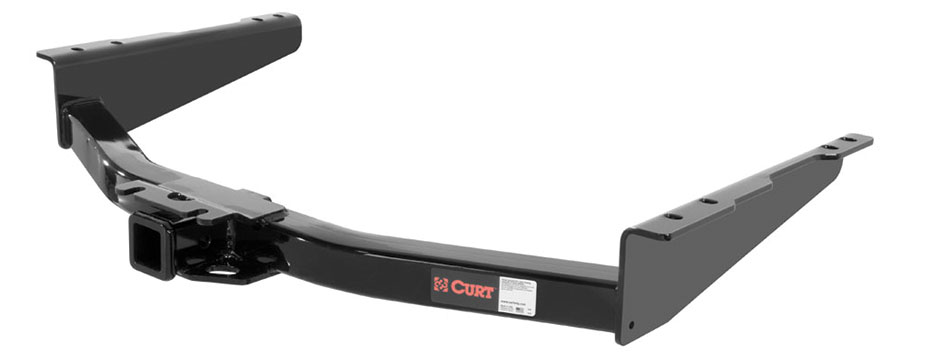
There are a number of towing components to consider when determining whether a StowAway Cargo Carrier will work with your vehicle. The following topics will guide you through the basic hitch and towing capabilities of a vehicle.
- Tongue Weight Capacity
- Hitch Classes
- Hitch Sizes
- StowAway Hitch Compatibility
- Hitch Converters
- Hitch Extenders
- Installing a Hitch on Your Vehicle
1) Vehicle Tongue Weight Capacity
When determining whether a StowAway Cargo Carrier will work with your vehicle, the first issue to consider is Tongue Weight Capacity. Tongue Weight Capacity refers to the maximum vertical weight that a vehicle’s frame can support in a normal driving environment.
Shorter, lighter vehicles tend to have lower Tongue Weight Capacities while larger, heavier vehicles tend to have higher Tongue Weight Capacities. Your best means of determining your vehicle's tongue weight capacity is to read your vehicle's owner's manual and to compare the information there with the certification plate on your driver's door sill. The owner's manual will provide detailed instructions and limitations, usually accompanied by tips for safe towing. A quick way to roughly estimate your vehicle’s Tongue Weight Capacity is to divide your vehicle’s Towing Weight Capacity by 10% (tongue weight = GTW x 10%).
Once you have identified your tongue weight capacity, subtract the weight of the rack to determine how much gear you can carry safely. For example, if you want to use a hitch bike rack and your vehicle has 1,500 lbs GTW, then you have 150 lbs tongue capacity. If the weight of the bike rack is 40 lbs, you have 110 lbs leftover for the weight of your bikes.
2) Hitch Classes
Why do you need to know your Vehicle’s Tongue Weight Capacity? Because it is an important factor in determining the receiver hitch class that automobile manufacturers will install and recommend for use with their vehicles.
Trailer hitches are commonly divided into five classes, based upon the strength and size of the vehicle they are intended to be used on. Hitches range from Class I (Light Duty Hitches) to Class V (Extra-Heavy Duty Hitches). The most common factory-installed hitch sizes on SUVs, Vans and RVs are Class III (Heavy Duty) and Class IV (Heavy Duty). Many smaller SUVs come equipped with Class II (Medium Duty) hitches.
The following chart shows the Tongue Weight Capacities that different hitch classes are designed to support.
Check your owner’s manual or contact your dealer to confirm the class rating of your factory-installed hitch. If you’re considering installing an after-market trailer hitch, please see Section 7 below for more information.
3) Hitch Sizes
Hitches are sometimes identified by size rather than class. Hitch size refers to the inside diameter of a vehicle’s hitch receiver opening. Class III and Class IV hitches have a diameter of 2 inches, thus they are often referred to as “2 inch receivers.” Class I and Class II hitches generally have a diameter of 1.25 inches, thus they are often referred to as “1 ¼ inch receivers.”
Note: Some manufacturers fabricate Class I and II hitches with a 2” hitch opening to accommodate a greater range of hitch accessories, so do not assume that a 2” opening equates to a Class III or Class IV receiver hitch.
Larger receiver openings will generally have greater Tongue Weight Capacities and smaller receiver openings will generally have smaller Tongue Weight Capacities. Check your owner’s manual, contact your dealer or simply measure your receiver opening’s diameter to determine the size of your hitch.
4) StowAway Hitch Compatibility
Every StowAway cargo carrier and rack slides directly into the hitch receiver that is mounted to your vehicle. StowAway carriers are designed for use with Class II (1.25 inch), III (2 inches) and IV (2 inches) hitches.
StowAway Standard Cargo Carriers, Bike Racks, and Hitch Racks are designed for use with with either Class II (1.25 inch) hitches or Class III and IV (2 inches). Carriers purchased for a Class II 1.25-inch hitch are intended for use on minivans and lighter-duty SUVs and have a carrying capacity of 125 pounds.
All StowAway carriers and racks can be used with Class III (2 inches) and Class IV (2 inches) hitches. Carriers purchased for a Class III or IV 2-inch hitch are intended for use on most SUVs, RVs and Vans and have a carrying capacity of 200 pounds.
5) Hitch Converters
Hitch Converters are hitch accessory items designed to change the size of the hitch receiver opening. The most common hitch converter for use with SUVs, Vans and RVs is the 1 ¼” to 2” hitch expander. The 1 ¼” to 2” hitch expander enlarges your hitch receiver opening from the smaller 1 ¼” opening to the larger 2” opening.
Note: using a Hitch Expander does not change the hitch’s class rating or Tongue Weight Capacity, it only changes the size of the receiver opening. For this reason, we do not recommend using a 1 ¼” to 2” hitch expander with any of our StowAway carriers. Attempting to use such a converter with one of our carriers could place undue stress on your vehicle’s frame and/or hitch.
Another common hitch converter is the 2” to 1 ¼” hitch reducer. This converter shrinks the larger 2” opening to the smaller 1 ¼” opening. These reducers will allow you to safely use one of our LT models on a vehicle with a 2” hitch receiver opening.
6) Hitch Extenders
Hitch Extenders are a hitch accessory item that increases the distance between the back end of your vehicle and the hitch receiver opening. Often, they are used to accommodate rear-mounted spare tires and ladders or to increase the turning clearance of a towed vehicle.
Due to the weight of a StowAway Cargo Carrier or Rack, we only recommend using a Hitch Extender on a Class 3 or above (2”) hitch. We also recommend the use of a Hitch Tightener to secure the junction between the hitch extender and the hitch, and the carrier's frame and the hitch extender. This is the surest way to eliminate any wobble or sway.
We do not recommend using a hitch extender on a 1.25” trailer hitch. We do not recommend using a Hitch Extender longer than 7 inches (measure from hitch pin hole to hitch pin hole on the Extender). We do not recommend using a Hitch Expander (a specialty extender that converts a vehicle’s 1.25” hitch to a 2” opening).
Also note that the use of a Hitch Extender in conjunction with a StowAway Cargo Carrier will decrease the carrying capacity of the StowAway by 1/3. Therefore, you should attempt to limit the weight of your gear to roughly 130 pounds when you use your StowAway with an Extender.
7) Installing a Hitch on Your Vehicle
If you intend to purchase an after-market trailer hitch, be sure to take into account your vehicle’s Tongue Weight Capacity. It is important to avoid purchasing and using a hitch that is designed for a heavier duty vehicle than the one you plan to use it with. A common misconception is that by placing a Class III or IV (2 inch) hitch on a lighter-duty SUV or even a car, the vehicle will be able to support the Tongue Weight Capacity that these heavier-duty hitches are designed to support.
This is an incorrect assumption that could very easily place undue stress on your vehicle’s frame and/or hitch if you were to max out your hitch’s Tongue Weight capacity. Your vehicle’s Tongue Weight Capacity will not increase when you install a hitch, even if the hitch is designed to support a weight greater than your vehicle’s Tongue Weight Capacity.
As a general rule, if your vehicle’s Tongue Weight Capacity is between 200 and 300 pounds, only consider purchasing and installing a Class II hitch. If your vehicle’s Tongue Weight Capacity is between 300 and 500 pounds, you can consider a class III or Class IV hitch. If your vehicle’s Tongue Weight Capacity is over 500 pounds, a Class IV hitch would be best.
8) Additonal Questions?
Contact one of our Cargo Carrier specialists via email, or call us toll free at 800.943.5377